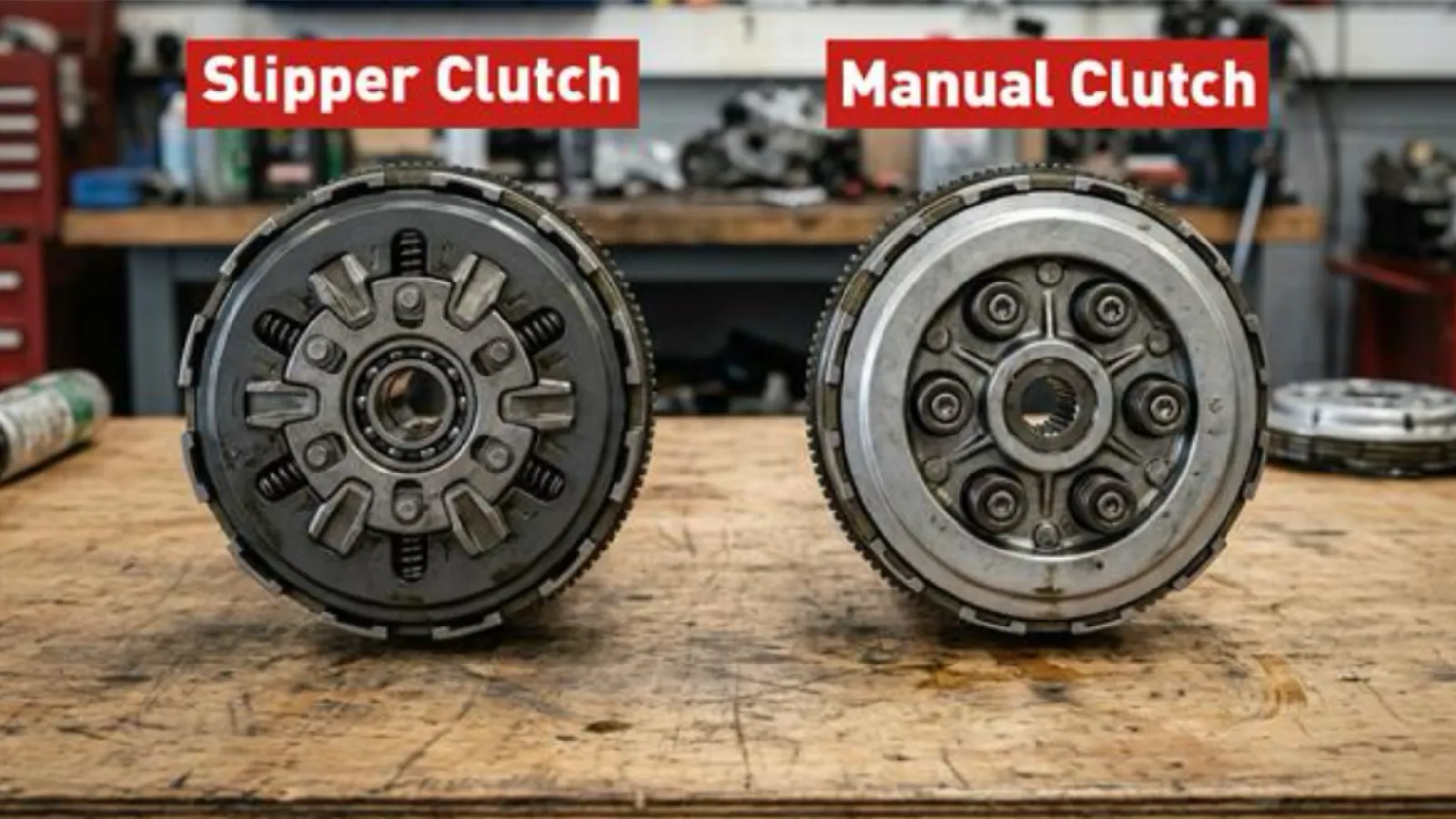
When you twist the throttle and feel your motorcycle respond, there is a quiet partnership at work between your engine and clutch. Whether you ride daily through traffic or push your bike on open roads, understanding the difference between a slipper clutch and a manual clutch can change how you experience control, comfort, and performance.
Let’s break it down in a way that feels less mechanical, and more like a rider’s perspective.
What a manual clutch is and how it works
A manual clutch is what most riders first learn on. It is simple, direct, and entirely dependent on the rider’s input.
When you pull the clutch lever, you temporarily disconnect the engine from the gearbox. This allows you to shift gears smoothly without damaging the transmission. Once you release the lever, power flows back to the wheels.
Think of it as a handshake between you and your motorcycle. Every gear change requires your timing and judgement. That is why riders often feel more “connected” when using a manual clutch.
For smaller motorcycles, especially those designed for city riding, a manual clutch for small engine setups works perfectly. It is reliable, easy to maintain, and gives you full control over power delivery.
What a slipper clutch is and how it works
A slipper clutch takes the same basic principle and adds intelligence to it.
While accelerating, it behaves like a regular clutch. But during aggressive downshifting, especially at high speeds, it automatically adjusts the pressure between clutch plates.
In simple terms, when the rear wheel tries to spin faster than the engine (a common situation during sudden downshifts), the slipper clutch partially disengages itself. This prevents the wheel from locking or hopping.
That is essentially how slipper clutch works—it reduces engine braking force when it could otherwise unsettle the bike.
Key differences between slipper clutch and manual clutch
At a glance, both clutches serve the same purpose, but their behaviour under stress is where they differ.
A manual clutch gives you total control, but also demands precision. If you downshift too quickly, you may feel jerks or instability.
A slipper clutch, on the other hand, acts like a safety net. It forgives aggressive inputs and smoothens out the ride.
In everyday riding, you may not notice a dramatic difference. But when riding hard, cornering fast, or braking sharply, the contrast becomes very clear.
How slipper clutches improve downshifting stability
Downshifting can be tricky, especially when done quickly before entering a corner.
Without assistance, the sudden drop in speed combined with engine braking can cause the rear wheel to hop or skid. This is not just uncomfortable, it can also be risky.
A slipper clutch steps in at exactly this moment. By reducing the load on the transmission, it keeps the rear wheel stable and planted.
This is one of the most practical slipper clutch benefits—it allows riders to focus more on the road and less on perfectly timing every gear change.
Performance benefits of slipper clutches in sport bikes
On sport bikes, performance is everything. Every second matters, and every movement needs to be precise.
A slipper clutch enhances this by:
- Allowing faster, more aggressive downshifts
- Reducing rider fatigue during intense riding
- Maintaining stability while braking into corners
- Improving overall lap consistency
For riders pushing their machines to the limit, this feature is less of a luxury and more of a necessity.
When a manual clutch is still the preferred choice
Despite all the advancements, the manual clutch still holds its ground.
For everyday commuting, especially in smaller bikes, it remains practical and cost-effective. It is easier to repair, widely understood, and gives experienced riders a sense of full mechanical control.
Some riders also simply prefer the raw, unfiltered connection a manual clutch provides. It feels more involved, more tactile, and in many ways, more satisfying.
How clutch type influences riding control and performance
The type of clutch you use subtly shapes your riding style.
With a manual clutch, control comes from skill and experience. You are actively managing every shift.
With a slipper clutch, the bike supports you, especially in demanding conditions. It reduces the chances of error and enhances confidence.
Neither is strictly better—it depends on what kind of rider you are and how you use your motorcycle.
How fuel additives help maintain smooth engine performance in motorcycles
While clutches manage how power is transferred, the quality of that power starts at the engine.
Over time, fuel systems can accumulate deposits, affecting combustion efficiency and throttle response. This can make gear shifts feel less smooth, regardless of whether you are using a slipper clutch or a manual clutch.
This is where Milex Fuel Additives come in.
By keeping the fuel system clean and optimised, MilexGlobal helps maintain consistent engine performance. The result is smoother acceleration, cleaner combustion, and a more refined riding experience overall.
Because at the end of the day, even the best clutch system performs better when the engine behind it is running at its best.
FAQs
Do all motorcycles come with a slipper clutch?
No, slipper clutches are typically found in sport bikes and higher-performance motorcycles. Many commuter bikes still use manual clutches.
Is a slipper clutch useful for beginner riders?
Yes, it can be helpful. It reduces the chances of mistakes during downshifting, making the ride more forgiving.
Can a slipper clutch reduce wheel hopping?
Yes, that is one of its main advantages. It prevents rear-wheel instability during aggressive downshifts.
Are slipper clutches only used in sports bikes?
Mostly, but not exclusively. Some premium commuter and touring bikes also feature them.
Does a slipper clutch require different maintenance?
Not significantly. Maintenance is similar to a manual clutch, though replacement parts may be slightly more specialised.
Whether you enjoy the precision of a manual clutch or the confidence of a slipper clutch, your ride is ultimately shaped by how well your motorcycle performs as a whole.
Keep it smooth. Keep it responsive. Keep it running right—with Milex Fuel Additives.
Related Reads for Slipper Clutch vs Manual Clutch: What’s the Difference?
If you’re comparing bike performance, control, and engine behavior, these articles will help you understand how fuel quality, engine response, and maintenance impact riding experience: